
Recording Mining Income When the Invoice and the Wallet Disagree
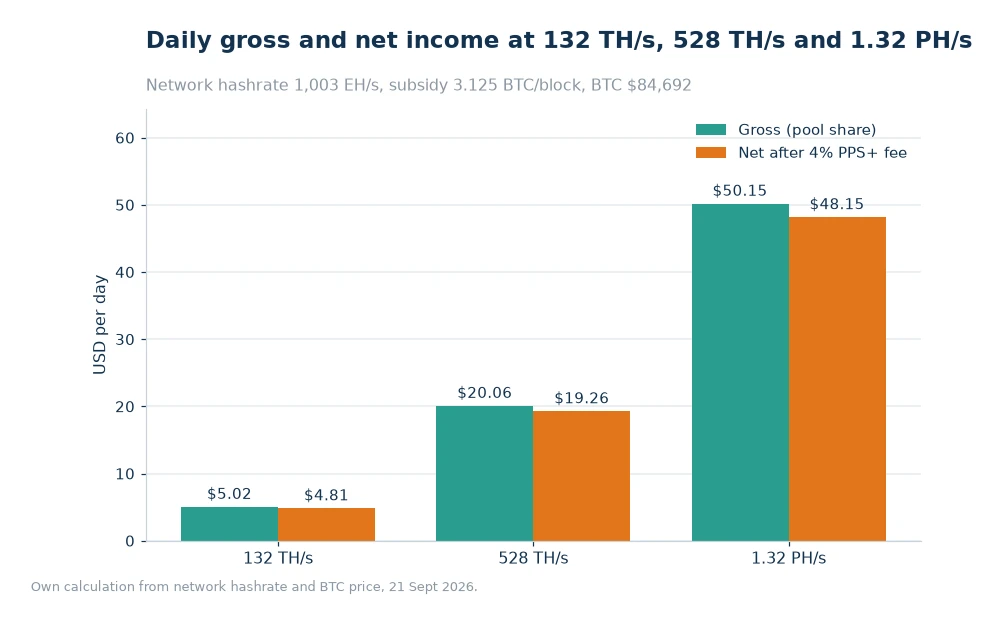
At the end of the month the pool statement, the wallet balance and the bank account rarely show the same figure, and none of them is wrong. At 132 TH/s the net credit is $4.81 a day, or $144.45 over thirty days, but the coins that arrived during the month were worth something different on each day they arrived. Bookkeeping has to choose a convention and apply it without flinching.

Key takeaways
- 132 TH/s produces 0.00005685 BTC a day net, which is $4.81 at $84,692.
- Thirty days of consistent output is $144.45, but the USD value depends on when it is measured.
- Record the fee as a cost, not as a smaller income, if the books separate gross and charges.
- Reconcile by BTC quantity first and by dollar value second; the coins are the auditable fact.
Three records, one month, three different numbers
The pool knows what it credited. The wallet knows what it holds. The accounting system knows what was booked. Those three systems answer different questions, and a month-end that tries to force them into one number produces a reconciliation nobody can explain later.
A clean set of books keeps them separate and links them with a bridge. Start with the coin quantity credited, because that is the only figure that cannot be argued with. Convert it at a stated rate and a stated time. Then note any withdrawal, its date and the amount that left. The bridge is short, and it survives an audit.
The disagreement usually comes from timing. Coins credited on the 30th may be withdrawn on the 2nd, and the rate used for the withdrawal is not the rate used for the credit. That is not an error; it is two events. Recording them as one is what creates the confusion.
Choose a valuation point and stick to it
There are three defensible conventions: the rate at the moment of credit, a single daily closing rate, or a monthly average. Each produces a different revenue figure and each is acceptable if applied consistently. Mixing them within one month is not.
For a small operation, the daily closing rate is the easiest to defend because it can be reproduced from a public source by anyone reviewing the books. The moment-of-credit rate is more precise but harder to evidence after the fact. The monthly average is simplest and least granular, which suits a business that only needs a defensible total rather than a daily ledger.
Write the choice in the accounting policy note, with the source and the timezone. A rate without a timezone is not a rate; it is a guess with decimal places. This single sentence prevents most of the arguments that arise a year later, when someone tries to reproduce the month from a different exchange's chart and finds a figure that is close but not equal.
The fee line belongs in the cost column
Under PPS+, the listed 4% applies to the block-reward component and the transaction-fee component follows a separate rate. If the books report gross income and a fee cost, the two lines reconcile with the pool statement. If they report only net income, the cost disappears and the operation looks more profitable than it is.
For a company, that difference matters beyond presentation. A cost that is never recorded is a cost that is never reviewed, and the fee is one of the few expenses that can be compared across pools. Keeping it visible is how a future migration decision gets made on evidence.
The ViaBTC Bitcoin Mining statements show gross and net separately for exactly this reason. Export them monthly and file the export with the bank statement; a PDF that arrives from the platform is better evidence than a screenshot of a dashboard.
Reconciling a short month without panic
A short month is normal. Difficulty moves, a machine goes offline for a day, or a payout cycle lands just outside the reporting period. The reconciliation should explain the gap rather than force it to zero.
Build a variance line: expected output at the month's average hashrate, actual credited output, and the difference explained by downtime hours. If the difference is larger than the downtime can account for, check the worker list for a machine that was renamed or removed. A worker that disappears from the list still appears in the historical series, so the two views together usually locate the change within a day.
Do not adjust the prior month to make the current one tidy. Adjusting closed periods is how a small discrepancy becomes an unexplainable one. Book the variance where it belongs and move on.
A practical safeguard is to keep a running daily log rather than reconstructing the month from a single statement. One line a day, containing the date, the credited coin, the rate used and the hashrate, gives thirty small entries instead of one large puzzle. The log also catches a machine that was down for two days, because the missing lines are visible before the total is calculated.
| Days | Cumulative net BTC | Value at $84,692 | Check |
|---|---|---|---|
| 7 | 0.00039795 | $33.70 | One week, full uptime |
| 14 | 0.00079590 | $67.41 | Half month, no outage |
| 30 | 0.00170550 | $144.45 | Full month at one difficulty |
Worked example
Take 132 TH/s and build the month-end entry line by line.
- Divide the daily 450 BTC by 1,003,000,000 TH/s and each terahash is credited 0.00000044865 BTC.
- At 132 TH/s: 132 × 0.00000044865 = 0.00005922 BTC a day gross.
- After the listed 4%: 0.00005922 × 0.96 = 0.00005685 BTC net.
- In dollars at $84,692: 0.00005685 × 84,692 = $4.815, or $4.81.
- Seven days: 0.00005685 × 7 = 0.00039795 BTC, about $33.70.
- Thirty days: 0.00005685 × 30 = 0.00170550 BTC, about $144.45.
- Withdraw on day 31 and the wallet shows the coin; the bank shows the proceeds at the withdrawal rate, not the credit rate.
The two dollar figures differ by whatever the rate did between credit and withdrawal. That difference is a valuation effect, not extra income and not a loss. Books that treat it as income will overstate revenue in a rising market and understate it in a falling one.
Frequently asked questions
Should mining income be recorded gross or net of the pool fee?
Record both: gross coin credited and the fee as a separate cost. That matches the pool statement, keeps the expense visible and lets the operation compare fees across providers without reworking the revenue line.
Which BTC price should be used for the month?
Any single convention applied consistently: the rate at credit, a daily close or a monthly average. State the source and timezone in the policy note so a reviewer can reproduce the figure, and do not switch conventions mid-year.
Why does the wallet show less than the month's credited output?
Usually because a withdrawal left the wallet, a payout cycle fell outside the period or a machine was offline for part of the month. Reconcile by BTC quantity first, then explain the dollar difference separately.
Close the month with a written method
A one-page method note beats a clever spreadsheet. It should state the valuation convention, the fee treatment, the reconciliation steps and the person responsible. Anyone who picks up the file next year should be able to reproduce the month without asking a question.
The multi-currency wallet is where the coin balance and withdrawal history live, and the fee schedule is the source for the cost line. With those two exports and the method note, the month closes in an hour instead of an afternoon.
Sources: the ViaBTC homepage, wallet and pricing pages for account records and listed rates[1]. Inputs on 21 Sept 2026: 1,003 EH/s network hashrate, 132.76 T difficulty and BTC $84,692. Published 24 Oct 2026; figures assume continuous uptime and a constant difficulty across the period.