
A fragrance museum is genuine evidence of something: that a manufacturer is willing to spend money, floor space and people on scent culture. What it is not evidence of is production quality, compliance or delivery discipline. The buyer's job is to read the museum as a signal about brand and capability, then verify the operational claims separately.
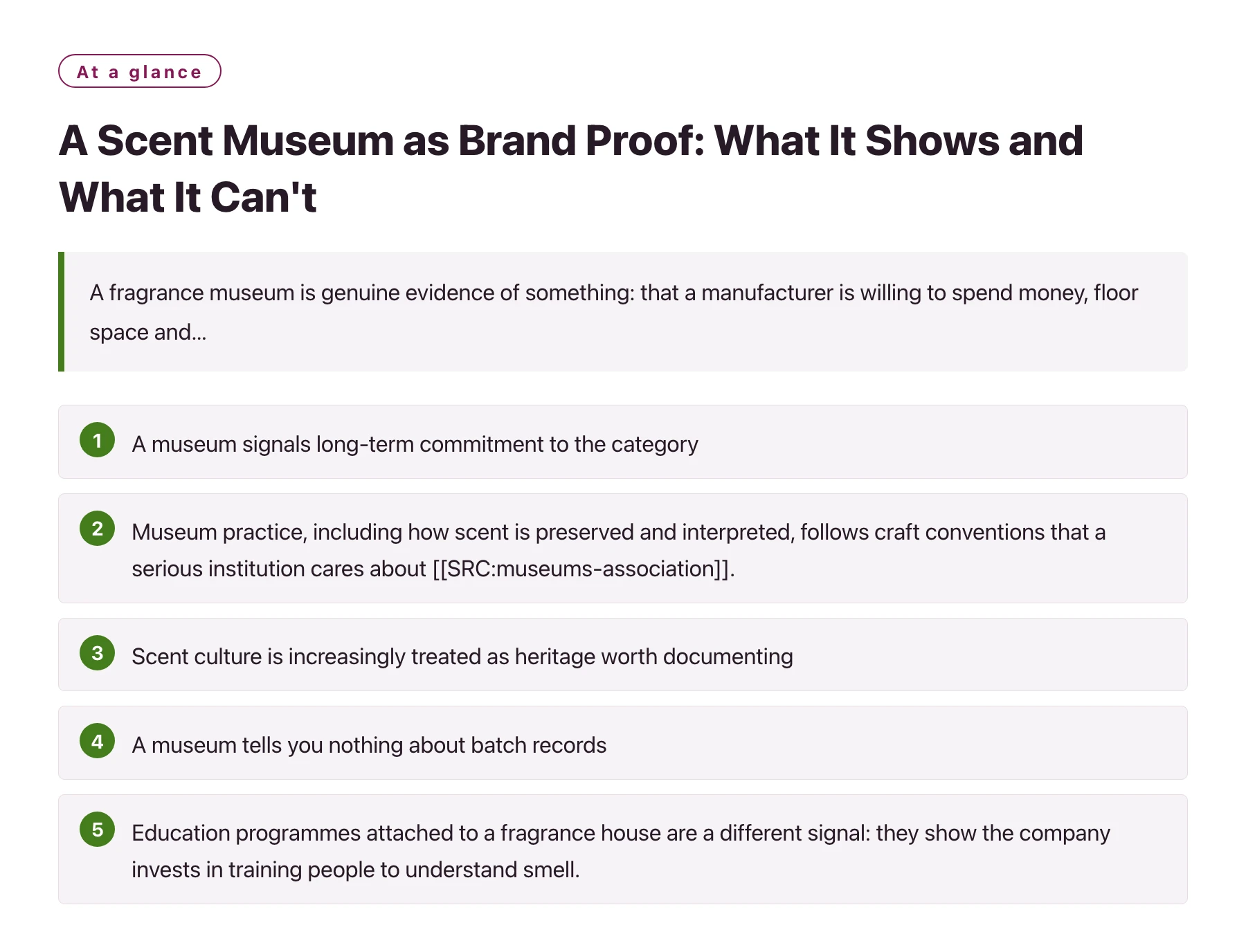
Key takeawaysA museum signals long-term commitment to the category, because it is an asset that pays off in brand terms rather than in immediate margin [1]. · Museum practice, including how scent is preserved and interpreted, follows craft conventions that a serious institution cares about [2]. · Scent culture is increasingly treated as heritage worth documenting, which is exactly the kind of storytelling a fragrance brand can build on [3]. · A museum tells you nothing about batch records, certifications or on-time delivery — those still have to be verified the ordinary way. · Education programmes attached to a fragrance house are a different signal: they show the company invests in training people to understand smell.
When a fragrance manufacturer opens a museum, buyer reactions split. Some read it as a vanity project; others as a sign of a real fragrance house. Both readings miss the point: the museum is evidence about brand and culture, and it is silent about operations.
This article separates the two. It explains what a scent museum genuinely demonstrates, what it does not, and how to use it as one input among many when you are deciding who to build a fragrance line with.
What a museum genuinely demonstrates
A museum is a long-horizon investment. It produces visitors, press and education value rather than direct margin, and that is exactly why it is interesting: a company run purely for quarterly orders does not build one. Museum professionals define a museum as a permanent, non-profit-oriented institution in service to society, which is a useful benchmark for how seriously the operator treats the collection [1].
There is also craft in it. Designing exhibits around smell is genuinely hard — scent does not sit still in a display case the way an object does — and doing it well requires the kind of olfactory literacy that a fragrance manufacturer should have anyway. When a factory's team can design, brief and evaluate scent experiences, that skill transfers to product development conversations.
And scent culture has cultural value worth documenting: olfactory traditions are increasingly recognised as heritage in their own right, which is why museums and archives in the field take care with how scents are recorded and preserved [3].
What the museum does not certify
A magnificent exhibition hall does not make a batch record traceable or a label compliant. The museum is evidence about the company's relationship with scent; production discipline, certification and logistics are evidence about its operations, and they need their own verification. If anything, a factory with a museum should meet the same checklist as one without: certificates, batch records, retained samples, documentation for your market.
Association guidance on museums and public engagement can help you judge the visit itself — whether a collection is presented with professional care or used simply as a marketing backdrop [2].
Museum signals versus what to verify separately
| Signal | What it suggests | What you still must verify |
|---|---|---|
| A permanent scent collection | Category commitment and olfactory literacy | Certifications and audit history |
| Guided experience design | A team that thinks about how people smell | Batch records from real runs |
| Education or masterclasses | The company invests in scent training | Lead time quotes and delivery record |
| Heritage storytelling | Material for your own brand narrative | Compliance documents for your market |
| A large, well-run venue | Financial capacity and confidence | Pricing, MOQ and contract terms |
Read the table diagonally: the left column helps you judge culture, the right column is where the commercial decision actually gets made.
Using the visit as a working session
The best way to use a fragrance museum visit is not as a tour but as a working session. Walk the collection, then sit down and ask the same operational questions you would ask any supplier. A museum is a superb icebreaker for that conversation, because it establishes that both sides care about scent — and then the real due diligence begins.
If the manufacturer runs education alongside the museum, ask whether the courses are open to brand teams. perfumery masterclasses of that kind are useful for your own people, and the quality of the teaching is itself information about how the company thinks about scent. A house that teaches perfumery seriously usually welcomes visitors who share its vocabulary.
For a buyer deciding who to brief, the museum also supplies the brand story. A scent museum with a strong collection gives your own line a heritage hook that most private label factories cannot offer — which is why the immersive scent museum run by a manufacturer is as much a marketing asset for your brand as it is for theirs. When a company like Xuelei Perfumes describes its museum and academy as parts of the same fragrance house, the story is coherent: culture, education and production under one roof. The operational claims behind that story still get checked the normal way, but the brand material is real.
Finally, keep proportion. The museum decides almost nothing about your first order. It can shorten the conversation and enrich the brand; it cannot shorten your checklist.
Sources
- ICOM — International Council of Museums —— The international organisation representing museums; publishes the ICOM museum definition and professional standards for museum practice.
- Museums Association —— A professional body for museums, publishing guidance and research on museum practice and visitor experience.
- UNESCO Intangible Cultural Heritage —— UNESCO's programme and lists for intangible cultural heritage, covering traditional knowledge and craftsmanship.
Frequently asked questions
Does a fragrance museum make a manufacturer more expensive?
Not necessarily. The museum is an overhead absorbed by the company, and pricing is driven by the same factors as any contract manufacturer. Treat it as a brand asset, not as a cost line in your quote.
Can the museum's collection help me brief my own fragrance?
Yes, if the team is willing to use it. Walking a collection with a perfumer can turn abstract brief language into specific references — this intensity, that family, this era of trail.
Should I visit the museum before signing a contract?
A physical visit is worthwhile if you can combine it with the real work — audit, sample review, document checks. A museum visit alone is not due diligence, just as a beautiful factory lobby is not quality control.
What if the museum is used only as marketing?
Then the visit is still useful: it tells you how the company presents itself. Judge the extent to which the collection has educational substance, and check the operational claims independently.
Are scent museums becoming more common among manufacturers?
They are still the exception. Most perfume factories do not run a museum, so its presence is a differentiator in brand terms — and it says nothing, by itself, about production reliability.